
Manual vs Automated Testing: Choose the Best Fit for Your Product
Every product that enters the digital market must undergo rigorous testing to ensure it functions as expected. Software bugs can damage user experience, tarnish reputation, and result in financial losses. Choosing the right Manual vs Automated testing method—can significantly influence the product’s quality, time-to-market, and long-term maintainability.
Manual Vs Automated Testing both play essential roles, but each serves a different purpose depending on the project’s goals, complexity, and timeline.
Manual testing involves human testers executing test cases without using automation tools. This approach is highly effective in exploratory, usability, and ad-hoc testing, where human intuition, attention to visual elements, and real-time judgment are essential.
Manual Software Testing is particularly useful during the early stages of development when features are still evolving and require continuous assessment. It helps detect UI/UX inconsistencies, identify functional glitches, and understand how real users may interact with the application. Additionally, manual testing provides flexibility, enabling testers to modify and adapt test cases in real-time as the product progresses.
While manual testing may be more time-consuming, it is cost-effective for small-scale applications or products in the MVP phase, where automation may not be financially justifiable.
Automation employs scripts and tools to swiftly and consistently carry out repetitive testing tasks. It is well-suited for large-scale products, regression testing, performance testing, and scenarios needing repeated test execution across various platforms.
Automated testing ensures faster feedback loops, reduces the possibility of human error, and improves test coverage across different user scenarios. Once automation scripts are developed, they can be reused, making it efficient for continuous integration and continuous deployment (CI/CD) pipelines.
However, automation is not suitable for every testing need. It requires upfront investment in tools and expertise, and may fall short in scenarios where visual cues or nuanced user interactions need to be evaluated.
The decision between manual and automated software testing depends on factors such as:
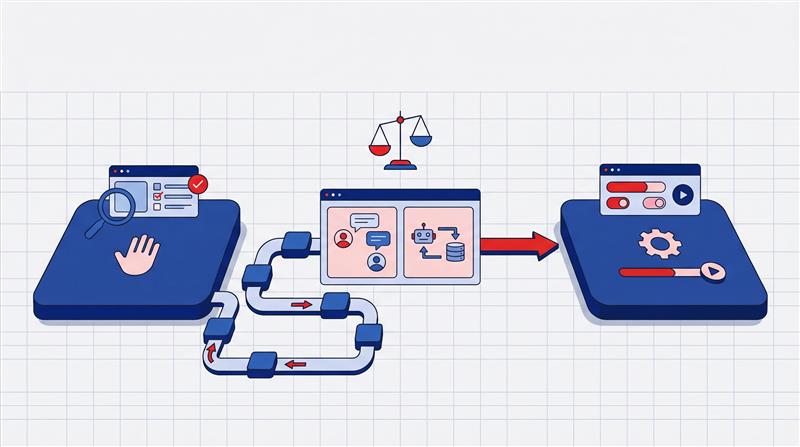
The ideal approach often involves a Hybrid Model, where critical tests are automated, and exploratory or UI-based tests are executed manually.
As a top software testing company, AcmeMinds helps businesses implement tailored testing strategies that balance speed, accuracy, and efficiency. Our team specialises in both Manual and Automated Software Testing, allowing us to adapt our methods based on your product’s unique requirements.
For early-stage applications or dynamic development environments, we offer detailed manual software testing services that focus on real-user experience, edge cases, and functional correctness. Our testers execute test cases with meticulous attention to usability, responsiveness, and accessibility, ensuring your product is ready for market launch.
For businesses requiring scalability and fast release cycles, we design and implement automation frameworks using industry-leading tools such as Selenium, Appium, TestNG, and JUnit. Our engineers automate repetitive test scenarios and integrate them with CI/CD pipelines, helping reduce release time while maintaining quality.
What sets AcmeMinds apart is our commitment to aligning testing strategies with your development cycle, product goals, and budget. We work closely with your team to assess when and where automation makes sense and when manual testing should be prioritized. Our goal is to ensure your digital products are stable, user-friendly, and reliable under real-world conditions.
Manual testing is performed by human testers who execute test cases without automation tools, focusing on usability, visual accuracy, and real user behavior. Automated testing uses scripts and tools to run repetitive tests quickly and consistently, making it ideal for regression, performance, and large-scale testing.
Manual testing is best used during early development stages, MVP launches, and scenarios requiring human judgment such as UI, UX, exploratory, and ad-hoc testing. It is especially useful when features are changing frequently and automation setup would be inefficient.
Automated testing is ideal for large or complex applications with frequent releases. It works best for regression testing, load testing, and repetitive test scenarios where speed, consistency, and broad test coverage are critical.
Automated testing requires a higher upfront investment in tools and skilled resources, making it more expensive initially. However, over time it delivers better ROI by reducing testing effort, minimizing human error, and accelerating release cycles.
Yes, most successful teams follow a hybrid testing approach. Critical and repetitive test cases are automated, while exploratory, UI, and usability testing are handled manually. This balance ensures both speed and quality throughout the development lifecycle.
AcmeMinds evaluates your product scope, development stage, budget, and release frequency to design a tailored testing strategy. By combining manual testing expertise with robust automation frameworks, we help businesses achieve faster releases without compromising software quality.