



Building Secure APIs in 2026: Best Practices for Authentication and Authorization
APIs sit at the center of how modern software works. Every mobile app, web product, and internal service depends on them to exchange data and trigger business actions. That scale also makes APIs one of the most targeted entry points for attackers. According to Akamai’s 2024 API Security Impact Report, 84% of security professionals experienced an API security incident in the past year.
The takeaway is clear: strong authentication and authorization are essential. They establish trust between systems and prevent attackers from exploiting weak access controls. Organizations that invest in secure API design protect sensitive data, meet compliance standards, and reduce operational and financial risk.
This guide explains the core methods and best practices for securing APIs, from modern authentication standards to authorization models, common vulnerabilities, mitigation strategies, and the testing tools used by engineering and security teams. The goal is simple: equip you with practical, real-world guidance to build APIs that can withstand today’s threat landscape.
Why Secure APIs Matter
APIs have effectively replaced traditional application boundaries. They expose data, automate internal workflows, and connect businesses with partners and customers. This openness creates opportunities and introduces risk. Attackers target APIs because they provide direct access to business logic, identity workflows, and sensitive datasets.
When APIs aren’t secured properly, they lead to data leaks, account takeovers, broken access control, privilege escalation, and widespread service disruption. These failures almost always trace back to weak authentication, inconsistent authorization rules, or overly exposed endpoints.
Strong API security ensures three things:
- Integrity – requests cannot be tampered with
- Confidentiality – sensitive data stays protected
- Continuity – systems remain stable even under attack
In short, secure APIs keep your digital operations trustworthy and resilient.
Understanding Authentication
Authentication verifies the identity behind every request. It establishes trust before your API processes any action. Modern systems rely on standardized authentication models that deliver strong protection while keeping user experience predictable and simple. The most relevant methods in API architecture today include OAuth 2.0, JSON Web Tokens, and API Keys. Each one fits a different operational need and risk profile.
OAuth 2.0
OAuth 2.0 remains the foundation for delegated access on the web. It allows users to authorize applications without sharing credentials. This separation of permissions protects sensitive identity data and reduces the risk of credential theft. OAuth suits products that depend on controlled access between multiple systems or user tiers.
When OAuth 2.0 Works Best
Consumer platforms, enterprise workflows, partner integrations, and SaaS environments that require limited and auditable access across different services.
Strengths: OAuth delivers a strong security posture with scoped permissions and consistent industry adoption. It supports complex integrations across distributed systems with clear auditability.
Limitations: OAuth requires thoughtful implementation. Mismanaged tokens introduce risk. Setup complexity slows teams that do not maintain disciplined identity governance.
Organizations turn to OAuth when they need reliable and transparent permission delegation across products, partners, or tenants.
JSON Web Tokens
JSON Web Tokens create a stateless authentication model. Every token carries signed claims the server can validate without storing session data. This property makes JWT popular in microservices, cloud native workloads, and event driven architectures. Engineering teams use JWT when performance and decentralization matter.
Strengths: JWT scales across distributed architectures because there is no dependency on a central session store. It supports expiry rules that help enforce predictable authentication lifecycles.
Limitations: JWT tokens grow large and become risky when stored insecurely. They must always travel through secured channels. Revoking tokens is challenging without a dedicated blacklist or introspection layer.
JWT helps teams deliver fast and lightweight authentication across services that need high throughput and minimal state management.
API Keys
API keys identify calling systems rather than individual users. They remain useful for server-to-server communication where the environment is trusted. Keys deliver a simple way to authenticate services and enforce rate limits or basic monitoring controls.
Strengths: API keys are easy to implement and work well for internal workloads or automated tasks that do not require user specific identity.
Limitations: API keys are weak when used alone because they lack user context. They require rotation and secure storage. They should never replace stronger authentication in public facing systems.
API keys provide value as a lightweight validation mechanism but function best when paired with additional security controls.
Understanding Authorization
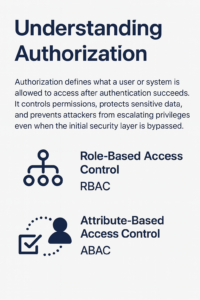
Authorization defines what a user or system is allowed to access after authentication succeeds. It controls permissions, protects sensitive data, and prevents attackers from escalating privileges even when the initial security layer is bypassed. Modern API ecosystems rely on two primary authorization models. Role Based Access Control and Attribute Based Access Control. Each model supports different operational needs and maturity levels within engineering organizations.
Role-Based Access Control
RBAC assigns permissions based on predefined roles. It works well in environments where responsibilities stay stable over time. Industries like finance, healthcare, and public sector operations use RBAC because it simplifies onboarding, improves governance, and creates predictable permission structures.
Strengths
RBAC delivers a clear, easy-to-audit permission model that aligns well with compliance requirements and reduces ambiguity during access reviews.
Limitations
RBAC becomes rigid in fast-changing teams and can lead to “role explosion” when organizations try to map every unique scenario into a fixed role structure.
RBAC remains a strong choice when user responsibilities follow consistent patterns across departments or product workflows.
Attribute-Based Access Control
ABAC grants access using attributes such as user identity, resource classification, time of request, location, and other contextual factors. This creates more flexible and dynamic authorization outcomes without relying on predefined roles.
Strengths
ABAC supports granular, context-aware policy decisions that adapt to complex access scenarios, including multi-tenant platforms and enterprise services with diverse user groups.
Limitations
ABAC requires strong policy governance, disciplined identity management, and a mature infrastructure to avoid inconsistent or overly complex rule sets.
ABAC suits organizations that operate at scale and need adaptable authorization logic across varied user types, environments, and business contexts.
Common API Vulnerabilities and How to Mitigate Them
APIs introduce unique attack surfaces because they expose business logic directly to the open internet. Modern threat reports show a rise in exploits that target gaps in authentication, authorization, validation, and identity governance. Understanding these risks helps teams build stronger API security strategies that reduce exposure and strengthen overall resilience.
- Broken Authentication
Weak or missing authentication allows attackers to assume identities or create automated credential attacks.
Mitigation: Use multi-factor authentication for sensitive actions. Enforce strong token lifecycles. Implement rate limits and anomaly detection for credential activity.
- Broken Authorization
Improper permission checks allow privilege escalation or unauthorized access to sensitive endpoints.
Mitigation: Adopt a Zero Trust posture. Validate permissions at every request. Use RBAC or ABAC consistently across services.
- Excessive Data Exposure
APIs often return more data than required because backend services are over permissive.
Mitigation: Filter responses at the server. Apply schema based responses. Review endpoints regularly to reduce hidden data leakage.
- Injection Attacks
Unvalidated inputs allow attackers to run malicious queries.
Mitigation: Apply input validation and output encoding. Use parameterized queries. Avoid constructing queries through string manipulation.
- Improper Rate Limiting
Lack of request limits creates opportunities for brute force attempts or scraping activity.
Mitigation: Apply per user and per IP rate controls. Use behavioral analytics to identify automated traffic patterns.
- Security Misconfiguration
Misconfigured CORS, expired certificates, or exposed development endpoints cause silent vulnerabilities.
Mitigation: Apply configuration baselines. Use automated scanners. Remove unused endpoints and enforce TLS for all API traffic.
Tools for API Security Testing
Strong API security requires continuous validation across the entire lifecycle. Modern security engineering teams rely on automated and manual tools to identify gaps early and monitor traffic in production. Selecting the right mix ensures coverage across authentication, authorization, data exposure, and business logic flaws.
- Static Analysis Tools
Tools like Bandit, Semgrep, and SonarQube scan code for insecure patterns. This creates early discovery before deployments reach production.
- Dynamic API Scanners
Solutions such as OWASP ZAP, Burp Suite, and Postman Security scan live endpoints. These tools identify runtime issues including broken access controls, injection flaws, or weak validation.
- API Gateway Security Features
Platforms like Kong, Apigee, and AWS API Gateway offer rate limiting, token validation, and request inspection. These reduce exposure by filtering untrusted traffic.
- Runtime Protection and Monitoring
Platforms such as Datadog, WAF integrations, and cloud logging tools identify anomalies that point to exploitation attempts. This helps teams react quickly when threats arise in production.
- Contract and Schema Testing
Tools such as Pact, Assertible, and OpenAPI validators keep API behavior aligned with expectations. This eliminates unintended data exposure caused by changes in backend logic.
Building a Mature API Security Program
API security cannot rely only on individual controls. Organizations gain stronger protection when they embed security across architecture, development culture, and operational practice. A mature program aligns engineering, DevSecOps, and compliance teams through predictable workflows.
- Adopt a Secure by Design Culture
Security improves when teams design API features with identity, access requirements, and data classification in mind. This reduces rework and prevents late stage vulnerabilities.
- Establish a Central Identity Strategy
A unified identity provider supports consistent authentication and authorization across services. This reduces fragmented logic and enforces shared security policies.
- Apply Zero Trust Principles
Zero Trust removes assumptions about trusted networks and enforces verification at every request. This model reduces lateral movement and limits blast radius when incidents occur.
- Automate Security in Pipelines
Security gates inside CI pipelines ensure that code scanning, dependency checks, and schema validation occur before deployment. This creates predictable enforcement without slowing delivery.
- Monitor and Review Endpoints Regularly
API inventories often drift as products grow. Quarterly reviews help teams identify unused endpoints, deprecated versions, and hidden data exposure risks.
Final Recommendations
API security is never a one-time implementation. Threats evolve. Businesses should adopt continuous monitoring, structured authentication frameworks, and dynamic authorization models. Strong internal standards help teams build APIs that support growth without compromising safety.
Engineering teams at AcmeMinds work across these security patterns while building digital products for clients. Real-world application of these principles ensures that APIs deliver both performance and safety.
Stat Source: Akamai
FAQs
1. What is the difference between authentication and authorization?
Authentication identifies who the user or system is. Authorization defines what that authenticated identity is allowed to access within the application or API.
2. Which authentication method is the most secure for APIs?
OAuth 2.0 provides one of the strongest security models for modern, distributed applications. It enables delegated access, token-based authentication, and fine-grained permission control without exposing user credentials.
3. Are JWTs safe for production use?
Yes. JSON Web Tokens are safe for production when stored securely, transmitted only over HTTPS, signed with strong keys, and rotated regularly. Proper expiration and revocation strategies are essential for maintaining security.
4. What causes most API breaches?
Most API breaches occur due to weak authentication, missing authorization checks, excessive data exposure, misconfigured endpoints, or lack of proper monitoring and rate limiting.
5. Should API keys be used for user authentication?
No. API keys are meant to identify applications or systems, not users. They do not verify user identity and should not be used for authentication. User authentication should rely on secure token-based mechanisms such as OAuth or OpenID Connect.
6. How often should tokens or API keys be rotated?
Tokens and API keys should be rotated according to a strict internal security policy. For most teams, monthly or quarterly rotation provides a good balance between security and operational stability.