

Integrating AI Features in Modern Applications: A Practical Guide for Product Teams
A few years ago, AI was treated like an experiment. Today, it sits at the center of how modern products are built and how users expect them to behave.
People no longer want to search, filter, and repeat the same actions. They expect the app to understand context, remember preferences, and make smart decisions in the background. The best products feel effortless because intelligence is built into the foundation, not added as an afterthought.
From a business lens, AI changes how companies grow. It improves engagement, increases retention, and reduces manual operational work.
According to industry research, 78% of organizations worldwide now use artificial intelligence in at least one business function. This indicates a shift from experimental AI projects to AI becoming a strategic and operational foundation for modern applications, driving productivity, personalization, automation, and business outcomes at scale.
This guide explains how to integrate AI features into real-world applications in a way that is scalable, measurable, and ready for production.
AI Use Cases That Deliver Real Business Impact
Personalization That Evolves With Every Interaction
AI-powered personalization allows applications to change in real time based on user behavior. Instead of fixed user segments, algorithms analyze micro interactions such as scroll depth, time spent, tap patterns, and navigation flows.
This creates experiences that feel custom built for every user. Over time, the system builds behavioral profiles that increase satisfaction and reduce churn.
Recommendation Systems That Influence Business Outcomes
Recommendation engines do not just suggest content. They guide decisions.
These systems analyze interaction history, similarity models, and temporal signals to surface the most relevant options. When designed correctly, they increase average order value, improve cross sell rates, and strengthen long-term engagement.
Intelligent Search That Understands Meaning, Not Keywords
Modern AI powered search systems use semantic understanding rather than keyword matching. They rely on natural language processing and vector embeddings to understand intent.
This improves accuracy, reduces failed searches, and helps users complete tasks faster.
Designing a Scalable AI Architecture
A scalable AI architecture starts with one simple goal. Your intelligence layer should never slow down your core product. To achieve this, AI components must be built as independent, production-grade systems rather than tightly coupled application features.
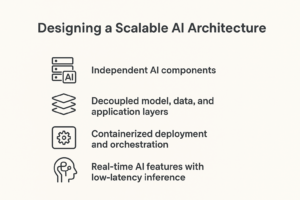
Successful teams separate their model layer, data layer, and application layer. Models are typically deployed as standalone services behind secure APIs, allowing them to be updated, scaled, and rolled back without disrupting the main product. Containerized deployment and orchestration help ensure that AI workloads scale automatically during high demand.
Real-time AI features, like recommendations or smart search, require low-latency inference pipelines. These pipelines prioritize fast memory access, optimized model serving, and efficient caching. For heavier workloads such as training and large-scale data processing, batch pipelines are used to prevent performance degradation in live systems.
This architecture approach ensures your AI systems remain reliable, fast, and easy to evolve as your product grows.
Building Reliable Data Pipelines for AI
Strong AI systems are built on strong data foundations. The accuracy and stability of your models depend heavily on how well your data is collected, processed, and governed in production.
Modern applications rely on real-time event pipelines to capture meaningful user behavior such as:
- Click patterns and navigation flow
- Session duration and feature usage
- Transaction behavior and drop-off points
This raw data cannot be used as-is. It must pass through structured processing layers that include:
- Data validation to remove corrupted or incomplete records
- Normalization to standardize formats across systems
- Enrichment to add contextual signals like device type or location
A dedicated feature store plays a critical role in mature AI systems. It helps by:
- Maintaining consistent feature definitions across teams
- Reducing training and inference data mismatches
- Preventing silent model degradation over time
- Improving trust in prediction reliability
When these pipelines are designed correctly, AI systems become predictable, scalable, and much easier to maintain in real-world production environments.
Choosing the Right AI Frameworks and APIs
The right tools can significantly reduce development time and technical risk. Mature AI frameworks and managed APIs help teams move faster without compromising stability, security, or performance.
When selecting frameworks, product teams typically look for:
- Proven performance in real world production environments
- Strong community support and long-term maintenance
- Flexibility to deploy on cloud and edge devices
Some of the most widely used options include:
TensorFlow
A powerful framework for building, training, and deploying machine learning models at enterprise scale. It supports distributed training, model optimization, and deployment across servers, cloud platforms, and edge devices.
Core ML
Designed for Apple ecosystems, Core ML enables machine learning models to run directly on iOS devices. This reduces server dependency, improves response times, and strengthens user privacy by keeping data on the device.
Cloud-Based AI APIs
Managed AI services provide prebuilt capabilities such as:
- Natural language processing
- Speech recognition and voice interfaces
- Image and vision analysis
- Recommendation and ranking services
These APIs help teams avoid heavy infrastructure management and focus on designing meaningful, high-impact user experiences.
Designing User Experiences for AI-Driven Features
Great AI experiences feel invisible. The technology should quietly remove friction, not create it. When designed well, AI makes apps feel faster, smarter, and easier without forcing users to think about how the system works.
Modern AI-enhanced user experiences now go far beyond basic recommendations. High-performing applications use intelligent features such as:
- Predictive autofill that completes forms using past behavior and contextual signals
- Dynamic interface layouts that reorganize menus and content based on user habits
- AI-powered onboarding that adapts tutorials and guidance based on how quickly a user learns
- Smart nudges and timing engines that deliver prompts only when a user is most likely to engage
Transparency still plays a critical role. Users feel more comfortable when they understand why they are seeing certain content or suggestions. Small UI elements such as “Why am I seeing this?” explanations or suggestion labels improve trust without adding complexity.
Measuring AI Performance with Meaningful Metrics
AI features only deliver value when their impact is clearly measured. Without structured measurement, even the most advanced models become expensive guesswork rather than performance drivers.
Effective teams track a balanced mix of business, product, and technical metrics, including:
- User engagement depth such as time spent, repeat usage, and feature adoption
- Task completion and success rates across key user journeys
- Conversion impact on sign-ups, purchases, or key actions
- Operational performance including latency, throughput, and system error rates
Beyond surface metrics, mature teams also monitor:
- Model accuracy and prediction confidence levels
- Real-time drift in model behavior over time
- Performance differences across user segments and contexts
A/B testing allows teams to compare AI-driven experiences against baseline versions in real production environments. This removes bias, eliminates assumptions, and provides statistically reliable insights.
Model Lifecycle Management in Production Systems
Once deployed, models start to drift as user behavior, market conditions, and data patterns change. Without proper lifecycle management, even high-performing models lose accuracy over time.
Reliable production AI systems include:
- Automatic model versioning to track changes over time
- Scheduled retraining pipelines using fresh, real-world data
- Continuous validation to detect performance drops
- Drift detection to identify changes in input data or prediction behavior
Strong lifecycle management delivers:
- Stable model behavior in real-world conditions
- Faster rollback when models underperform
- Better auditability for enterprise and regulatory needs
- Long-term system reliability without manual firefighting
Security, Privacy, and Compliance in AI Systems
AI systems operate on highly sensitive behavioral and operational data. High maturity AI platforms implement:
- End-to-end encryption for data in storage and transit
- Role-based and policy-driven access control
- Strict separation of training, staging, and production environments
- Tamper-proof audit logs that track model access and decisions
When AI systems are designed with privacy and governance at the core, organizations can scale safely and confidently.
Common AI Implementation Pitfalls to Avoid
Most AI failures do not happen because of weak models. They happen because of weak systems.
The most common mistakes include:
- Treating AI like a surface-level feature instead of core infrastructure
- Ignoring data quality and data ownership
- Skipping monitoring after deployment
- Failing to plan for retraining and long-term maintenance
Final Thoughts on Integrating AI Into Modern Applications
AI is no longer a feature you experiment with. It has become a core part of how modern products are designed, built, and scaled.
The most successful applications do not “add” intelligence later. They engineer it into the foundation from the start, allowing systems to learn, adapt, and improve with every user interaction.
At AcmeMinds, we help organizations design and build AI-ready products with the right architecture, data foundations, and governance in place from day one, so innovation feels natural, reliable, and scalable.
Stat source: AI usage statistics
FAQs
1. How do you integrate AI features into an existing application?
To integrate AI into an existing application, start by identifying high-value AI use cases such as personalization, semantic search, or recommendations. Build a reliable data pipeline, choose a production-ready AI framework, and deploy models as independent API services. This ensures your AI features are scalable, secure, and easy to update.
2. What is the best architecture for AI-powered applications?
The best architecture for AI-driven applications uses a decoupled model layer, data layer, and application layer. AI models are deployed as standalone microservices behind secure APIs, enabling low-latency inference, horizontal scaling, and faster updates. This architecture ensures your AI system supports real-time recommendations, predictions, and automation without slowing down the core app.
3. Which AI frameworks and APIs should product teams use?
Product teams commonly choose frameworks like TensorFlow, PyTorch, and Core ML for building and deploying AI models. For faster development, many rely on cloud-based AI APIs for NLP, computer vision, speech recognition, and recommendations. The right choice depends on your production workload, performance needs, and deployment environment.
4. How do you design user experiences for AI-powered features?
AI-powered UX should feel natural and invisible. Use AI to personalize content, automate repetitive tasks, predict user intent, and adapt the interface based on behavior. Adding transparency elements—like “Why am I seeing this?”—builds trust and reduces user friction. Well-designed AI UX improves engagement, retention, and overall product satisfaction.
5. What metrics should companies track to measure AI performance?
To measure AI performance, track a mix of technical and business metrics: model accuracy, latency, drift, error rates, user engagement depth, conversion impact, and task-completion performance. A/B testing AI features against non-AI baselines ensures accurate, real-world validation and helps teams prove the ROI of AI-driven experiences.
6. How do you manage the model lifecycle in production AI systems?
Effective model lifecycle management includes automated versioning, continuous monitoring, scheduled retraining, and drift detection. These processes ensure that AI models stay accurate as user behavior and data patterns evolve. Strong lifecycle management prevents performance degradation and keeps AI features reliable in long-term production environments.