

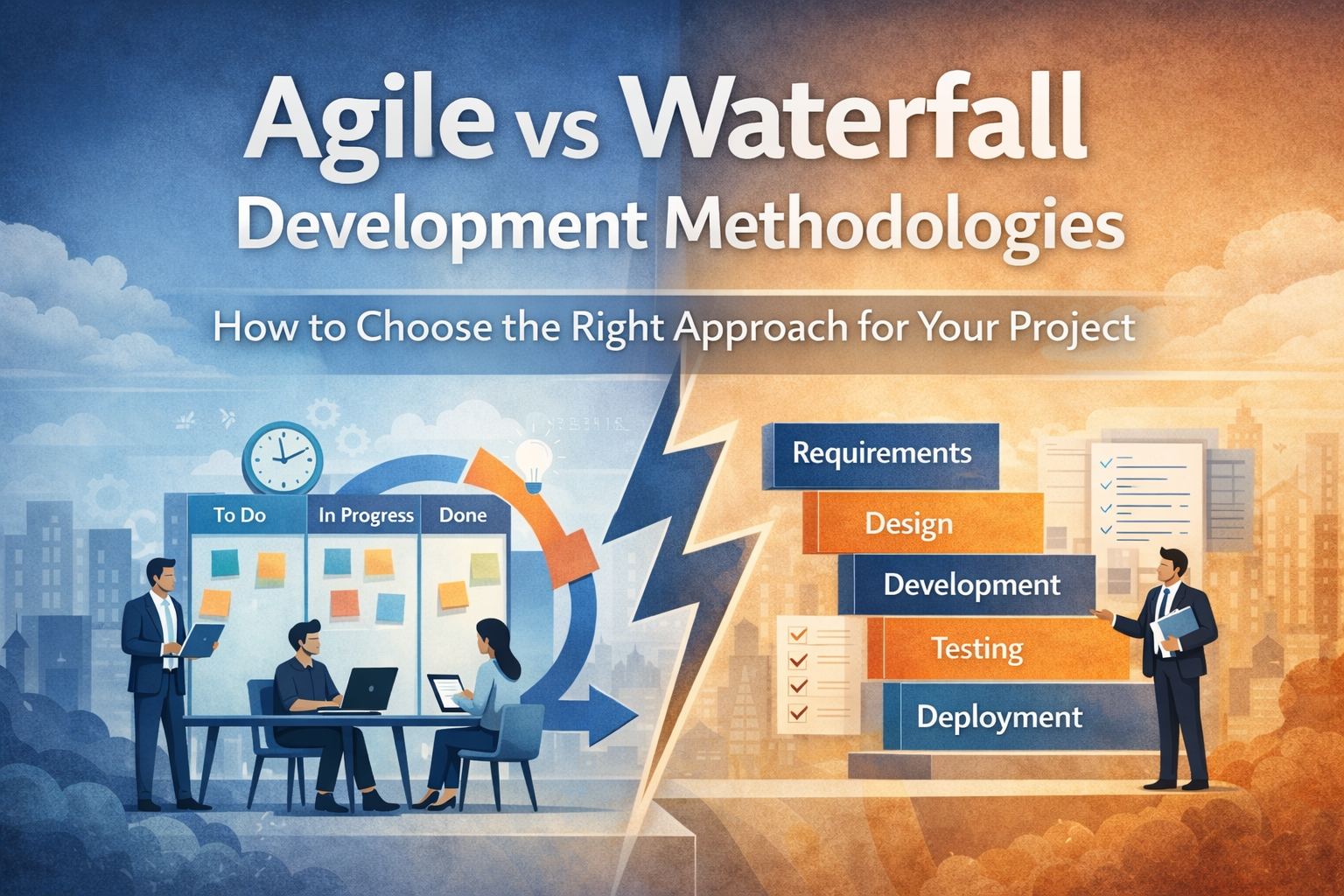
Agile vs Waterfall Development Methodologies. How to Choose the Right Approach for Your Project?
Choosing the right development methodology is one of the earliest and most consequential decisions in any software project. It shapes how teams plan work, manage risk, respond to change, and ultimately deliver value to the business. Agile and Waterfall remain the two most widely adopted approaches, yet they represent very different ways of thinking about structure, collaboration, and delivery.
Agile emphasizes adaptability, frequent feedback, and incremental progress. Waterfall prioritizes upfront planning, predictability, and clearly defined phases. Both approaches can lead to successful outcomes when applied in the right context, and both can cause friction when misaligned with project goals or organizational maturity.
This guide looks beyond surface-level comparisons. It explains how Agile and Waterfall actually work in real-world environments, where each methodology performs best, and how modern teams increasingly combine elements of both to balance speed with control. The goal is not to promote one method over the other, but to help decision-makers choose an approach that fits their product, team, and long-term business objectives.
What Is Agile Methodology?
Agile is an iterative software development methodology focused on flexibility, collaboration, and continuous improvement. Work is delivered in small increments called sprints, typically lasting two to four weeks.
Key characteristics of Agile development include:
- Continuous customer feedback throughout the project
- Cross functional collaboration between teams
- Frequent releases of working software
- Ability to adapt quickly to change
Agile methodologies commonly include Scrum, Kanban, SAFe, and Extreme Programming.
What Is Waterfall Methodology?
Waterfall is a linear and sequential development methodology. Each phase must be completed before the next phase begins. Requirements are defined upfront and changes later in the project are limited.
Typical Waterfall phases include:
- Requirements gathering
- System and software design
- Development
- Testing
- Deployment
- Maintenance
Waterfall works best when requirements are stable and well documented from the start.
Agile vs Waterfall. Key Differences Explained
| Aspect | Agile | Waterfall |
|---|---|---|
| Development style | Iterative and incremental | Linear and sequential |
| Flexibility | High | Low |
| Customer involvement | Continuous | Minimal after requirements |
| Change management | Easy to accommodate | Costly and difficult |
| Delivery | Frequent releases | Single final delivery |
| Best suited for | Evolving products | Fixed scope projects |
This comparison is often featured in search results because it clearly answers how Agile and Waterfall differ.
Benefits of Agile Development
Agile provides strong advantages for modern digital products and fast moving markets.
Primary benefits of Agile include:
- Faster time to market due to incremental releases
- Early detection of issues through continuous testing
- Higher customer satisfaction from frequent feedback
- Better risk management by delivering value early
According to the 2023 State of Agile Report by Digital ai, 71 percent of organizations report faster delivery as a key benefit of Agile adoption. Source. Digital ai State of Agile Report.
Challenges of Agile Methodology
Agile is not without limitations and requires maturity to execute well.
Common Agile challenges include:
- Difficulty predicting timelines and budgets
- Dependency on active stakeholder involvement
- Risk of scope creep without strong backlog management
- Requires experienced teams and disciplined processes
Agile works best when teams are empowered and decision making is decentralized.
Benefits of Waterfall Development
Waterfall remains relevant for certain project types and regulated industries.
Key benefits of Waterfall include:
- Clear structure and documentation
- Predictable timelines and costs
- Easier onboarding due to detailed requirements
- Well suited for compliance driven projects
Industries such as healthcare, defense, and construction often favor Waterfall due to strict regulatory needs.
Challenges of Waterfall Development
While Waterfall offers structure and predictability, it also introduces limitations that can affect outcomes when projects involve uncertainty or evolving user needs. These challenges become more visible in modern digital and software driven environments.
Key challenges of Waterfall include:
- Limited flexibility to accommodate change
- Late discovery of usability or quality issues
- Reduced stakeholder and user feedback during execution
- Longer time to visible value
These challenges make Waterfall less suitable for projects where requirements are uncertain, innovation is critical, or rapid feedback is essential. As a result, many organizations now reserve Waterfall for environments with stable scope, low tolerance for change, and strong regulatory oversight.
How to Choose Between Agile and Waterfall
Choosing between Agile and Waterfall is not about which methodology is better in general. It is about which one aligns with your business context, risk profile, and delivery expectations.
Most failed implementations happen when teams adopt a methodology because it is popular rather than because it fits the project. The right approach depends on how stable your requirements are, how much change you expect during development, and how closely stakeholders want to stay involved.
A practical way to decide is to evaluate a few core decision factors before committing to a development model.
Key Decision Factors
When teams assess Agile versus Waterfall, they usually focus on timelines or cost. In reality, the stronger indicators are requirement stability, feedback frequency, and governance needs.
The questions below help surface those realities early.
Consider Agile if:
Agile works best in environments where learning and iteration are part of the process rather than an exception.
You should lean toward Agile when:
- Requirements are expected to evolve as the product takes shape and market feedback becomes clearer
- Speed, experimentation, and innovation matter more than following a rigid plan
- Continuous user or stakeholder feedback is essential to shaping the final solution
- You are building a customer-facing digital product such as a SaaS platform, mobile app, or data-driven service
In these scenarios, Agile allows teams to release value incrementally, validate assumptions early, and reduce the risk of building the wrong thing. Short development cycles make it easier to course-correct without major rework.
Consider Waterfall if:
Waterfall remains effective when predictability, control, and documentation outweigh the need for flexibility.
It is often the right choice when:
- Requirements are fixed, clearly defined, and unlikely to change after approval
- Regulatory compliance, audits, or contractual obligations require detailed documentation at every stage
- The project scope is stable and well understood from the start
- Stakeholder involvement is limited once requirements are signed off
Industries such as healthcare, government, infrastructure, and defense often favor Waterfall because it supports traceability, formal reviews, and controlled handoffs between phases.
This decision framework frequently appears in featured snippets because it directly addresses user intent with clear, situation-based guidance.
Hybrid Development Approaches
Many organizations find that real-world projects do not fit neatly into a single methodology. As a result, hybrid development approaches have become increasingly common, especially in enterprise environments.
Hybrid models combine the structure of Waterfall with the adaptability of Agile, allowing teams to manage risk without sacrificing responsiveness.
Rather than replacing one methodology with another, hybrid approaches selectively apply each where it adds the most value.
Common Hybrid Models
Agile–Waterfall Hybrid
This model uses Waterfall-style planning and requirement definition upfront, followed by Agile execution during development.
It works well when high-level requirements must be approved early, but teams still need flexibility during build and testing.
Scrumfall
In Scrumfall, planning and design phases follow a traditional Waterfall structure, while development and testing are executed using Scrum practices.
This approach is often used by organizations transitioning from Waterfall to Agile and looking for a gradual shift rather than a complete transformation.
SAFe (Scaled Agile Framework)
SAFe is designed for large enterprises that need to scale Agile across multiple teams while maintaining governance, compliance, and alignment with business strategy.
It introduces structured planning layers without removing Agile delivery principles, making it suitable for complex, multi-team programs.
Hybrid approaches reduce delivery risk while preserving adaptability. When applied thoughtfully, they help organizations balance speed, quality, and control without forcing teams into rigid methodological boundaries.
Agile, Waterfall, or Hybrid. Which Is Best
Agile and Waterfall are not competing philosophies so much as tools designed for different conditions. Projects with evolving requirements, fast feedback loops, and close stakeholder involvement tend to benefit from Agile’s flexibility. Initiatives with fixed scope, regulatory constraints, or high dependency on upfront documentation often align better with Waterfall’s structured flow.
Many organizations today operate somewhere in between. Hybrid models allow teams to plan strategically while still responding to change, making them a practical choice for complex or enterprise-scale systems. The most effective teams focus less on labels and more on outcomes, adjusting their process as the product and market evolve.
Selecting the right development methodology is ultimately a business decision, not just a technical one. It requires clarity on risk tolerance, delivery timelines, team capabilities, and customer expectations. When those factors are understood, the methodology becomes an enabler rather than a constraint.
If you are evaluating Agile, Waterfall, or hybrid delivery models for your next project, the team at AcmeMinds works with organizations to align development strategy with real-world execution and long-term growth.
FAQs
1. What is the main difference between Agile and Waterfall?
Agile follows an iterative and flexible approach, while Waterfall uses a fixed, sequential process with clearly defined phases.
2. Is Agile better than Waterfall for software development?
Agile is better suited for evolving products with changing requirements, while Waterfall works best for projects with stable and well-defined requirements.
3. Can Agile and Waterfall be used together?
Yes. Many organizations adopt hybrid models that combine Waterfall’s structured planning with Agile’s execution flexibility.
4. Which methodology is best for startups?
Agile is typically the better choice for startups because it supports rapid iteration, experimentation, and continuous customer feedback.
5. Is Waterfall outdated?
No. Waterfall remains effective for regulated industries and projects with minimal change and strict compliance requirements.
6. How do I decide the right methodology for my project?
Choose the right methodology by evaluating requirement stability, stakeholder involvement, risk tolerance, and delivery timelines.