


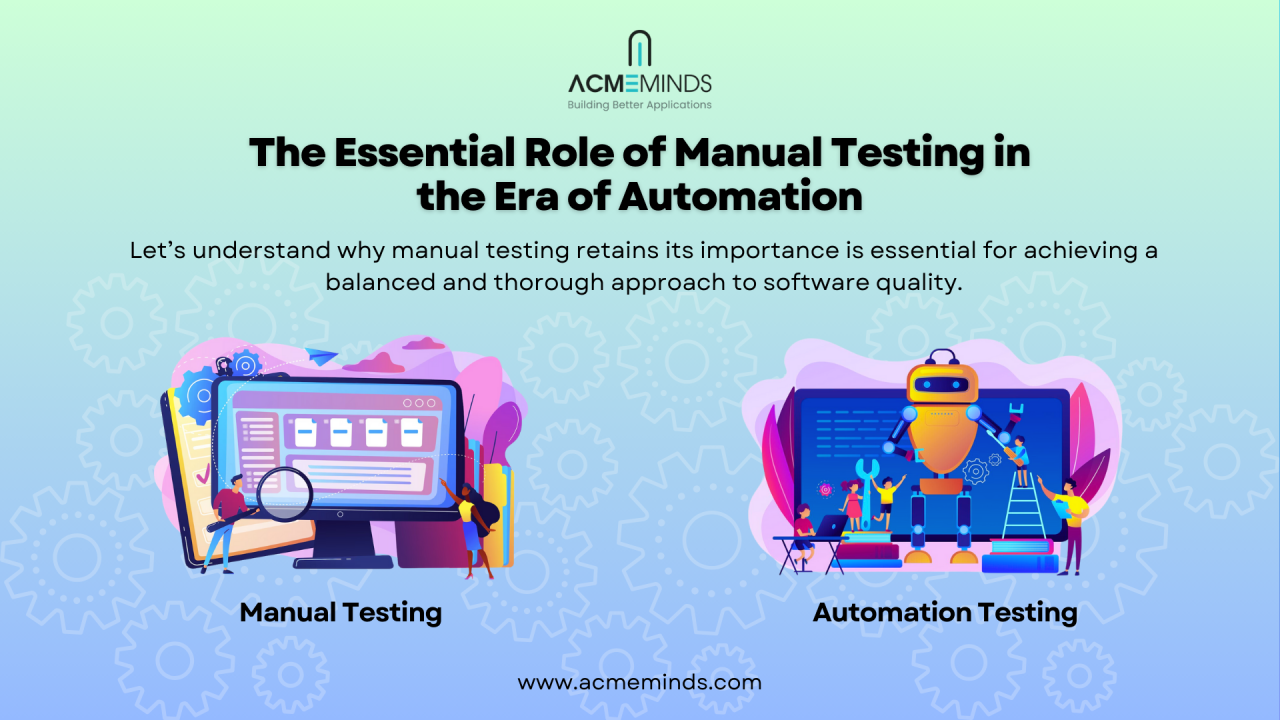
Manual Testing Critical Role in the Automation Era
Manual Testing proves indispensable for usability and UX verification and edge-case bug detection even with the automation age. The following explanation demonstrates its significance.
Introduction
The digital transformation has pushed software testing among its most affected domains in its ongoing shift towards automation. Software testing receives significant advantages through the implementation of Selenium and Appium and Cypress automation tools which deliver better scalability and speed and reduced costs. The software development life cycle (SDLC) relies on manual testing to maintain its essential position.
The combination of automation technology excels at regression testing and repetitive tasks and performance benchmarking but manual testing remains indispensable for exploratory testing and usability assessment and edge case validation. This article examines both the significance of manual testing and its relationship to automation systems along with strategies businesses can use to achieve proper automation-manual testing equilibrium.
What Is Manual Testing?
The process of running test cases manually operates without any dependence on automation tools. The end-users perform tasks as testers to confirm that software meets its expected behavior. This testing approach depends on the tester’s personal knowledge and their ability to understand the system and their natural intuition and creative skills.
Key Use Cases:
Exploratory Testing
UI/UX Feedback
Ad-hoc Testing
Short-Term or One-off Projects
Testing Newly Developed Features
Why Manual Testing Still Matters
-
Human-Centric Validation
Some issues exist beyond the detection range of machines. Testers who perform manual testing can discover visual problems and awkward user interfaces which automated systems tend to miss.
-
Exploratory Testing & Intuition
Automated test cases are pre-scripted. The human testers use their ability to think and their instincts to perform software exploration and reveal hidden software problems.
-
Flexible and Adaptive
The testing method works best when system requirements remain undefined or when they change often. Real-time decision-making remains possible through this method without needing to modify code or scripts.
-
Cost-Effective for Short Projects
The lack of budgetary resources prevents short projects from investing in automation systems. The process provides fast and efficient validation services.
-
First-Time Test Scenarios
New features need manual testing before developers can create automation scripts. This approach helps verify feature stability alongside expected behavioral results.
How Manual Testing Complements Automation
The practice of automation should work to improve manual testing instead of replacing it. A successful QA strategy combines both methods to reach the best possible outcomes.
Hybrid Testing Approach:
Automated testing should handle recurring stable tests which include login procedures and forms and API requests
Manual Testing should be used to assess UI/UX elements and perform exploratory testing as well as initial rounds of assessment
AcmeMinds supports a hybrid testing approach to shorten release periods while maintaining high-quality standards.
Explore AcmeMinds’ Software Testing Services to discover how we balance manual and automated testing for digital excellence.
FAQs
-
Can Manual Testing be eliminated completely?
No. The execution of repetitive tasks by automation leaves room for human decision-making in UX assessments and accessibility testing and exploratory tests.
-
When is Manual Testing better than automation?
The testing process requires manual methods for both new feature assessments and UI/UX feedback collection and small project applications and requirements with frequent changes.
-
Is Manual Testing cost-effective?
Yes, especially for startups or MVPs with limited budgets and frequently changing requirements.
-
How does AcmeMinds integrate Manual Testing?
We implement manual testing alongside automation to achieve high speed and precision. The manual testing team assesses user experience while the automated system delivers large-scale testing capabilities.
-
What skills are required for manual testers?
A manual tester requires essential skills that include critical thinking and domain knowledge along with communication abilities and attention to detail and test planning and execution understanding.
Conclusion
The modern automation age needs manual testing because it plays a vital role in quality assurance. Automated scripts prove useful in saving time and effort yet they fail to deliver complete quality assurance due to their inability to provide human perspective. The integration of manual testing with automation provides businesses with complete coverage and usability assurance.
Our team at AcmeMinds understands the worth of both testing methods and uses customized QA plans that meet the specific needs of your project. Manual testing serves as a foundation for delivering high-quality software in both MVP development and complex system scaling.
At AcmeMinds, we specialize in building scalable, secure, and user-centric custom software for startups, SMBs, and enterprises.
Need help deciding which option is right for you ?
Consult with an AcmeMinds to evaluate your requirements, budget and growth plans.Making the right choice today can save you the time, money and headaches in the future. You can also follow us or join our LikedIn Community.