

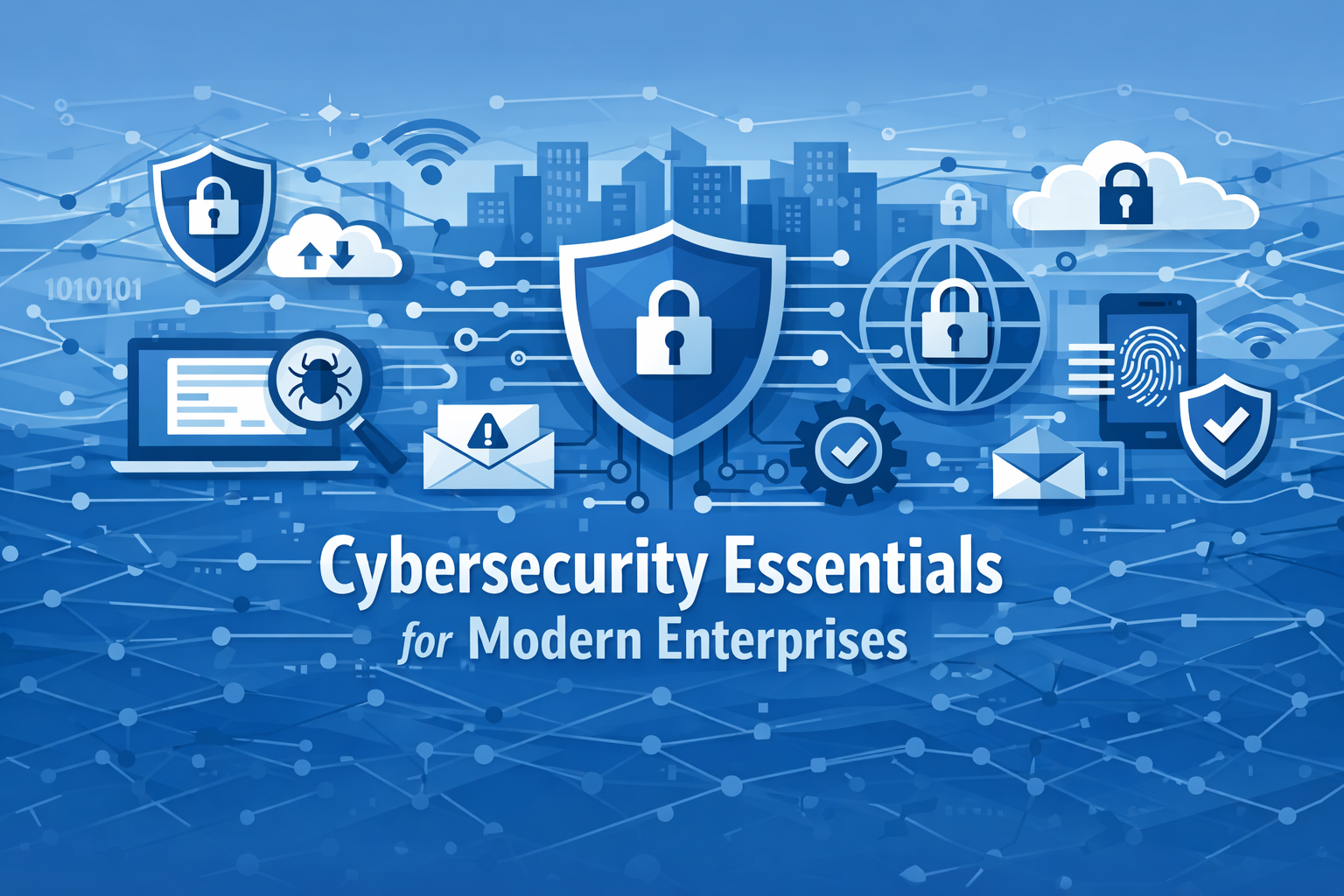
Cybersecurity Essentials for Modern Enterprises
Cybersecurity has become a core business concern for modern enterprises. As organizations rely more heavily on digital systems, cloud platforms, and remote work environments, the risk of cyber incidents continues to rise. Cybersecurity failures no longer affect only IT teams. They impact revenue, customer trust, regulatory standing, and long term business continuity.
According to IBM’s Cost of a Data Breach Report, the average cost of a data breach reached 4.45 million dollars globally, highlighting how costly security gaps have become for enterprises.
This article outlines the essential cybersecurity practices every modern enterprise should understand and implement to reduce risk and build resilient systems.
The Modern Enterprise Cybersecurity Landscape
Enterprise environments have become more complex. Organizations operate across cloud platforms, mobile devices, third party vendors, and remote workforces. This expanded digital footprint increases the number of potential attack paths.
Common enterprise cybersecurity risks include:
• Ransomware and data extortion attacks
• Credential theft and unauthorized access
• Misconfigured cloud environments
• Supply chain and vendor related breaches
• Insider threats caused by human error
Understanding this landscape is the first step toward building effective defenses.
Foundational Cybersecurity Practices Every Enterprise Needs
Strong cybersecurity starts with disciplined fundamentals. These practices reduce exposure and create a stable security baseline.
Risk Assessment and Asset Visibility
Enterprises must maintain a clear inventory of systems, applications, and data assets. Regular risk assessments help prioritize protection efforts based on business impact.
Multi Factor Authentication
Requiring more than a password significantly reduces unauthorized access. Multi factor authentication should be enforced for remote access, administrative accounts, and critical systems.
Least Privilege Access
Users should only have access to what they need to perform as per their role. Access rights must be reviewed regularly and adjusted as responsibilities change.
Identity and Access Management for Secure Operations
Identity has become one of the most targeted attack surfaces. Strong identity and access management controls help prevent unauthorized system entry.
Effective IAM strategies include:
• Centralized identity management
• Role based access controls
• Automated user provisioning and removal
• Regular access reviews and audits
Modern enterprises also adopt Zero Trust principles where access is verified continuously rather than assumed.
Network, Endpoint, and Cloud Security Essentials
Enterprise systems are no longer confined to a single network. Security controls must extend across all environments.
Network Security
Firewalls, traffic monitoring, and segmentation help limit lateral movement inside the network.
Endpoint Security
Employee laptops, mobile devices, and workstations require endpoint protection tools, encryption, and remote management capabilities.
Cloud Security
Cloud environments require strict identity controls, secure configuration management, and continuous posture monitoring to prevent data exposure.
Data Protection and Encryption Best Practices
Data protection is a legal and business responsibility. Encryption ensures sensitive information remains protected even if systems are compromised.
Key data protection practices include:
• Encrypting data at rest and in transit
• Implementing secure key management
• Maintaining regular and immutable backups
• Limiting access to sensitive datasets
These controls help reduce the impact of breaches and support regulatory compliance.
Incident Response and Business Continuity Planning
Cyber incidents cannot always be prevented. Enterprises must be prepared to respond quickly and recover effectively.
A strong incident response plan includes:
• Defined response roles and responsibilities
• Clear escalation procedures
• Regular tabletop and simulation exercises
• Communication plans for customers and regulators
Business continuity planning ensures operations can resume with minimal disruption after an incident.
Cybersecurity Frameworks and Industry Compliance
Security frameworks provide structure and consistency for enterprise programs.
Commonly adopted standards include:
NIST Cybersecurity Framework
Provides a flexible risk based approach across identify, protect, detect, respond, and recover functions.
ISO 27001
Defines requirements for building and maintaining an information security management system.
Industry Specific Standards
Examples include PCI DSS for payment data and HIPAA for healthcare information. Following recognized frameworks strengthens governance and audit readiness.
Building a Security Aware Organizational Culture
Employees play a critical role in enterprise cybersecurity. Many incidents start with simple mistakes rather than advanced attacks.
Organizations should invest in:
• Ongoing security awareness training
• Phishing simulations and education
• Clear security policies and reporting channels
• Leadership support for security initiatives
A security aware culture reduces risk across every department.
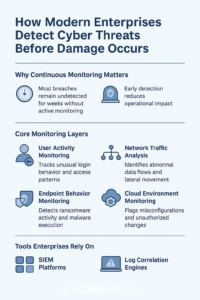
Continuous Monitoring and Threat Detection
Cyber threats evolve constantly. Continuous monitoring allows organizations to detect suspicious activity early.
Modern enterprises rely on:
• Security monitoring platforms
• Centralized log analysis
• Alerting and response workflows
• Threat intelligence feeds
Early detection significantly reduces the cost and impact of security incidents.
At AcmeMinds, we help organizations protect what matters most. Their data, systems, and reputation. Our cybersecurity experts design practical solutions that keep security simple, effective, and aligned with the highest standards of compliance, including HIPAA, GDPR, SOC 2, and PCI DSS. We focus on building security programs that support business growth while reducing risk and operational complexity.
FAQs
1. What is enterprise cybersecurity?
Enterprise cybersecurity refers to the policies, tools, and processes used to protect large-scale business systems, data, and operations from cyber threats.
2. Why is cybersecurity important for modern enterprises?
Cybersecurity protects revenue, customer trust, intellectual property, and regulatory compliance in an increasingly digital business environment.
3. What are the most important cybersecurity controls for enterprises?
Identity management, data encryption, access control, continuous monitoring, and incident response are foundational cybersecurity controls for enterprises.
4. What is the NIST Cybersecurity Framework?
The NIST Cybersecurity Framework is a widely used model that helps organizations manage and reduce cybersecurity risk through structured security functions.
5. How often should enterprises conduct security assessments?
Enterprises should conduct security risk assessments regularly and whenever there are significant changes to systems, infrastructure, or business operations.
6. Can cybersecurity improve business resilience?
Yes. Strong cybersecurity reduces downtime, limits financial losses, and supports long-term operational stability and business continuity.