

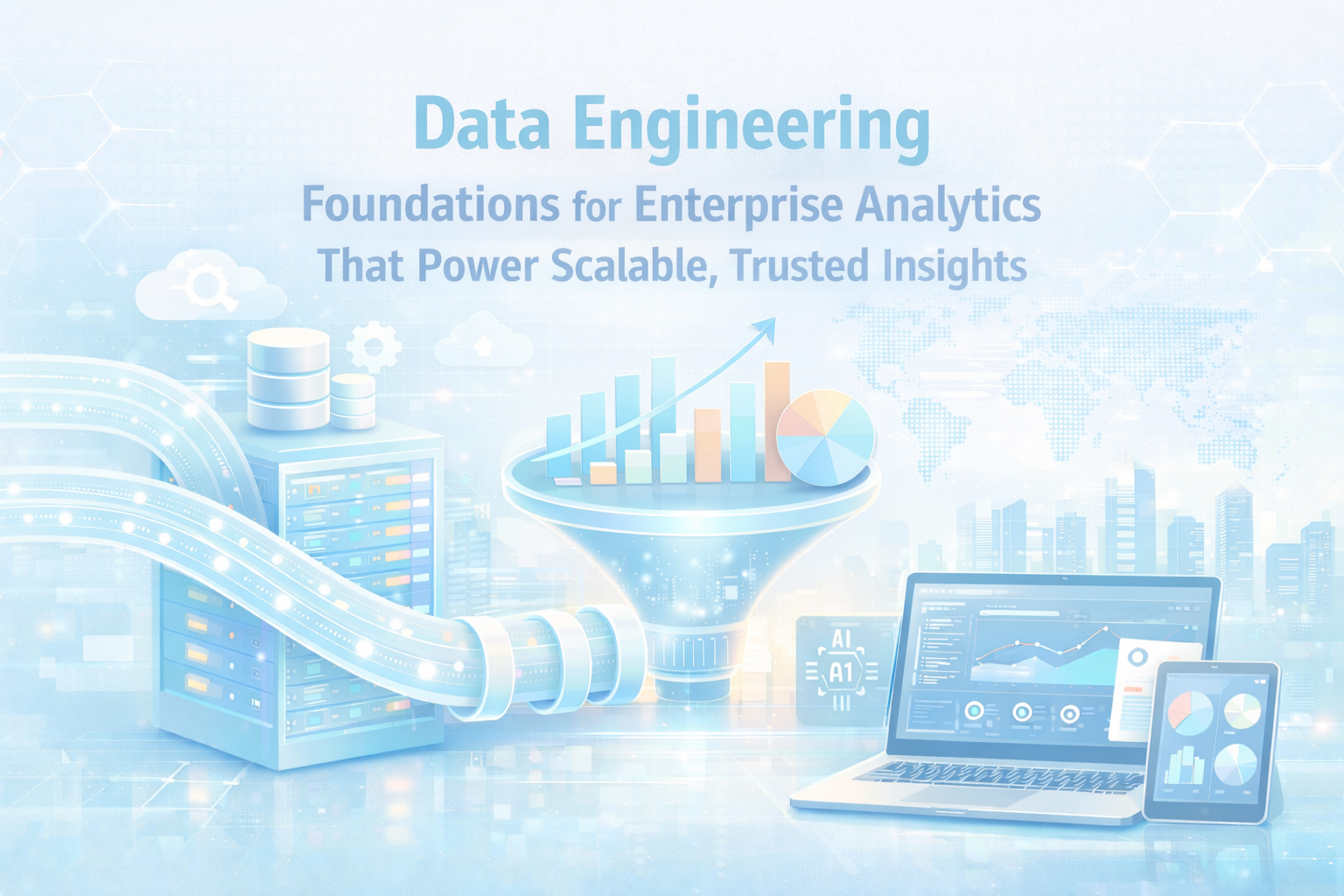
Data Engineering Foundations for Enterprise Analytics That Power Scalable, Trusted Insights
Why Data Engineering Is Foundational to Enterprise Analytics
Enterprise analytics success is determined long before dashboards are built or reports are shared. It begins with how data is collected, structured, validated, and delivered across the organization. Data engineering establishes the systems that ensure analytics data is reliable, timely, and aligned with business definitions.
In complex enterprises, analytics often fails due to inconsistent metrics, delayed data availability, and low trust in numbers. These issues stem from weak engineering foundations rather than analytics tooling. Industry research shows that poor data quality affects nearly 30 percent of business operations and costs organizations an average of $15 million per year.
Why this matters to enterprises
- Reduces conflicting reports and metric discrepancies
- Improves confidence in executive and operational decisions
- Enables analytics to scale across teams and regions
What Are Data Engineering Foundations
Data engineering foundations represent the core technical and operational capabilities that support analytics at enterprise scale. These foundations ensure that analytics teams receive data that is structured, governed, and ready for consumption.
Rather than treating data preparation as an ad hoc activity, mature organizations establish standardized pipelines, transformation logic, and governance processes that apply consistently across use cases.
Core components of data engineering foundations
- Ingestion frameworks for batch and streaming data
- Scalable storage using data lakes and warehouses
- Transformation and modeling layers
- Embedded data quality controls
- Governance, security, and access management
Enterprise Data Architecture for Analytics at Scale
Enterprise analytics architectures are designed as layered systems to balance flexibility, performance, and control. Each layer serves a specific function while integrating with upstream and downstream systems.
Source systems generate raw data through operational applications, platforms, and devices. The ingestion layer ensures reliable data movement. Storage layers separate raw data from curated analytics datasets. Processing layers apply business logic. Consumption layers deliver insights to business users and data science workflows.
Typical architecture layers
- Source systems including applications and third-party platforms
- Ingestion for batch and real-time data flows
- Data lakes for raw and semi-structured data
- Data warehouses for analytics-ready datasets
- Analytics and AI consumption layers
Designing Reliable Data Pipelines
Data pipelines are responsible for delivering data consistently and predictably to analytics environments. At enterprise scale, reliability and observability are as important as throughput.
Well-designed pipelines anticipate schema changes, data spikes, and upstream system failures. Engineering teams implement monitoring and alerting to detect issues before they impact analytics consumers.
Enterprise pipeline best practices
- Idempotent processing to prevent duplicate records
- Automated retries and failure handling
- Schema evolution management
- Observability into pipeline health and latency
Use case example
Retail and logistics organizations often rely on batch pipelines for financial reconciliation while operating parallel near-real-time pipelines to support inventory visibility and demand forecasting.
ETL vs Real-Time Processing in Enterprise Analytics
The decision between ETL and real-time processing depends on business latency requirements rather than technology preference. Each approach supports distinct analytics needs.
ETL remains critical for historical reporting and reconciliation workloads where accuracy and auditability are required. Real-time processing supports operational and event-driven analytics where immediate response delivers value.
When to use ETL
- Financial and regulatory reporting
- Historical trend analysis
- Enterprise performance dashboards
When to use real-time processing
- Fraud detection and risk monitoring
- Operational analytics
- Customer behavior tracking
Enterprise reality
- Most organizations use hybrid architectures combining both approaches
Data Quality as an Engineering Responsibility
In mature analytics environments, data quality is embedded directly into data engineering workflows rather than addressed after issues arise. Engineering teams design pipelines that validate data continuously and surface anomalies early.
Quality controls focus on preventing inaccurate or incomplete data from entering analytics systems. This approach reduces downstream rework and improves trust in insights.
Key data quality dimensions
- Accuracy of values
- Completeness of records
- Timeliness of data delivery
- Consistency across systems
Engineering practices
- Validation rules at ingestion
- Profiling and anomaly detection
- Reconciliation between source and target data
Data Governance for Trusted Enterprise Analytics
As analytics adoption expands, governance ensures data remains secure, compliant, and trustworthy without restricting access. Governance frameworks define how data is owned, documented, and protected.
Effective governance supports self-service analytics by providing clarity around data meaning and usage while enforcing enterprise policies.
Governance capabilities
- Clear data ownership and stewardship
- Role-based access control
- Metadata and lineage visibility
- Compliance and policy enforcement
Enterprise Use Cases Enabled by Strong Data Engineering
Robust data engineering foundations enable enterprises to move beyond fragmented reporting toward scalable analytics and AI initiatives that support both strategic and operational decision-making. When data pipelines are reliable, governed, and performance-optimized, organizations can confidently deploy analytics use cases across business functions without constant rework or manual intervention.
Strong data engineering ensures that data is consistent, timely, and trusted, which is essential for analytics use cases that influence revenue, risk, compliance, and customer experience.
Executive Dashboards with Trusted Metrics
Executive dashboards rely on consistent definitions and reconciled data across multiple business units. Without strong data engineering, leadership teams often face conflicting metrics that undermine confidence and slow decisions.
With well-engineered pipelines and governance frameworks in place, executive dashboards deliver a single source of truth by standardizing transformations and metric logic at the data layer rather than in individual reports.
Business impact
- Consistent KPIs across finance, sales, operations, and leadership views
- Faster strategic decision-making supported by reliable data
- Reduced time spent validating numbers during executive reviews
Customer Behavior Analytics
Understanding customer behavior across digital and physical touchpoints requires integrating data from multiple sources, including applications, transactions, and interaction logs. Without strong engineering foundations, customer data remains siloed and difficult to analyze holistically.
Data engineering enables unified customer views by standardizing ingestion, resolving identities, and applying consistent business logic across channels.
Business impact
- Deeper insights into customer journeys and engagement patterns
- Improved segmentation and personalization strategies
- Better alignment between marketing, sales, and product teams
Financial and Regulatory Reporting
Financial reporting and regulatory compliance depend on accuracy, auditability, and repeatability. These use cases place strict requirements on data quality, lineage, and governance, making them highly sensitive to weak engineering practices.
Strong data engineering embeds validation, reconciliation, and traceability directly into pipelines, ensuring reports meet regulatory standards and withstand audits.
Business impact
- Reduced risk of reporting errors and compliance issues
- Faster close cycles and reporting timelines
- Improved audit readiness and data traceability
Machine Learning Feature Pipelines
Machine learning initiatives depend on high-quality, consistent feature data for training, inference, and model monitoring. Without engineered feature pipelines, data scientists often spend excessive time preparing data instead of improving models.
Data engineering enables reusable, versioned feature pipelines that deliver consistent data to machine learning workflows across environments.
Business impact
- Faster model development and deployment
- Consistent features between training and production
- Improved model performance and reliability over time
Across all enterprise use cases, strong data engineering provides the foundation that allows analytics and AI initiatives to scale confidently. By enforcing quality, governance, and performance at the data layer, organizations reduce operational risk and increase the business value of analytics investments.
FAQs
1. What are the data engineering foundations in enterprise analytics?
Data engineering foundations are the systems and processes that ensure analytics teams receive accurate, timely, and governed data at scale. They include data pipelines, storage architectures, transformation frameworks, and governance controls that prepare raw data for reliable business analysis.
2. Why is data engineering critical for analytics success?
Data engineering is critical because analytics outcomes depend on data quality, reliability, and consistency. Without strong engineering foundations, analytics teams spend more time validating data than generating insights, which limits decision-making speed and trust.
3. What is the difference between ETL and real-time processing?
ETL processes data in batches and is typically used for historical reporting, reconciliation, and regulatory analysis. Real-time processing delivers insights as events occur and supports operational use cases such as monitoring, alerts, and customer interactions.
4. How does data governance support analytics adoption?
Data governance supports analytics adoption by ensuring data is consistent, secure, and well-documented. Clear ownership, access controls, and metadata help business users trust analytics outputs and confidently use data for decision-making.
5. What causes most enterprise analytics failures?
Most enterprise analytics failures are caused by poor data quality, unclear data ownership, and fragile data pipelines. These issues lead to inconsistent metrics, delayed insights, and low confidence in analytics results.
6. How does data engineering support AI initiatives?
Data engineering supports AI initiatives by providing clean, consistent, and well-governed datasets for model training and deployment. Reliable pipelines ensure that AI models receive high-quality data throughout their lifecycle, improving accuracy and long-term performance.