

How Microservices and Containerization Simplify Enterprise Application Development
In today’s fast-paced digital landscape, enterprises need scalable, efficient, and agile solutions to build and manage applications. Traditional monolithic architectures often struggle with scalability, maintenance, and deployment challenges. This is where microservices and containerization come into play, offering an innovative approach to enterprise application development.
Understanding Microservices and Containerization
Microservices is an architectural style that structures an application as a collection of loosely coupled services, each responsible for a specific function. Instead of a single, large codebase, microservices allow independent development, deployment, and scaling, making applications more flexible and manageable.
Containerization involves packaging an application and its dependencies into a lightweight, portable container that can run consistently across different environments. Containers isolate software processes, ensuring smooth operation regardless of the underlying infrastructure.
How Microservices Simplify Enterprise Application Development
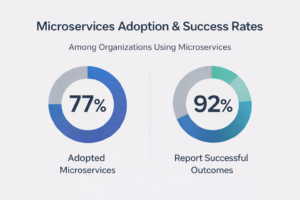
Industry research shows that 74% of enterprises are actively using microservices architecture, indicating widespread adoption across modern software teams.
- Scalability & Flexibility
- Enterprises can scale individual microservices independently, allowing optimal resource allocation.
- Different teams can develop, test, and deploy services without affecting other components.
- Faster Development & Deployment
- Teams can build and deploy services separately, reducing time-to-market.
- Continuous integration and deployment (CI/CD) pipelines streamline updates and feature rollouts.
- Improved Fault Isolation
- If a single microservice fails, it doesn’t affect the entire application.
- Easier debugging and troubleshooting since services operate independently.
- Technology Agnostic Approach
- Different microservices can be developed using various programming languages, databases, or frameworks.
- Enterprises can leverage the best tools for each service without being locked into a single technology stack.
How Containerization Enhances Enterprise Development
- Consistent Environments
- Containers ensure that applications run consistently across development, testing, and production environments.
- Developers can eliminate the “it works on my machine” problem.
- Efficient Resource Utilization
- Containers use fewer resources compared to virtual machines (VMs), leading to cost savings.
- Multiple containers can run on a single host, improving efficiency.
- Simplified Deployment & Portability
- Containers package applications with dependencies, making them easy to deploy across different cloud providers or on-premises.
- Enterprises can quickly scale services up or down based on demand.
- Enhanced Security & Isolation
- Containers isolate applications, reducing the risk of security vulnerabilities spreading.
- Enterprises can apply strict security policies to control access and data flow.
How AcmeMinds Helps Enterprises with Microservices and Containerization
AcmeMinds empowers businesses by implementing microservices and containerization strategies tailored to enterprise needs. Our expertise ensures that applications remain scalable, resilient, and easy to manage. Here’s how we assist:
- Microservices Architecture Design
- We design and implement microservices architectures that align with business goals.
- Our team ensures service independence, allowing seamless scaling and updates.
- Containerization & Orchestration
- We leverage Docker and Kubernetes to containerize applications for improved efficiency.
- Our experts manage containerized environments, ensuring smooth deployment and monitoring.
- CI/CD Implementation
- We integrate automated CI/CD pipelines, enabling continuous delivery of features and bug fixes.
- Our process minimizes downtime and accelerates time-to-market.
- Security & Compliance
- We implement security best practices in microservices and containerized environments.
- Our team ensures compliance with industry standards and regulations.
- Cloud & Hybrid Deployments
- We help enterprises deploy containerized microservices on cloud platforms like AWS, Azure, and Google Cloud.
- Hybrid and multi-cloud strategies ensure maximum uptime and flexibility.
By adopting microservices and containerization with AcmeMinds, enterprises achieve agility, faster development cycles, and robust application performance. Our tailored solutions drive efficiency and innovation, making businesses future-ready.
FAQs
1. What are microservices in enterprise application development?
Microservices are an architectural approach where an application is built as a collection of independent services. Each service handles a specific business function and can be developed, deployed, and scaled independently. This makes enterprise applications more flexible, resilient, and easier to evolve over time.
2. How does containerization help enterprise applications?
Containerization packages applications along with all their dependencies into portable containers. This ensures consistent behavior across development, testing, and production environments while simplifying deployments, improving scalability, and reducing infrastructure and operational costs.
3. What is the difference between microservices and containers?
Microservices define how an application is architected and broken down into smaller services, while containers define how those services are packaged and run. Microservices focus on application structure, whereas containerization focuses on deployment, portability, and environment consistency.
4. Why are Docker and Kubernetes important for microservices?
Docker enables lightweight and portable container creation, while Kubernetes handles container orchestration at scale. Together, they allow enterprises to automate deployments, manage service scaling, ensure high availability, and maintain operational stability across complex microservices environments.
5. Are microservices suitable for all enterprise applications?
Microservices are best suited for large, complex, and rapidly scaling enterprise applications. Smaller applications may not require this level of architectural complexity. However, growing enterprises benefit from microservices through faster releases, improved agility, and better fault isolation.
6. How does AcmeMinds support microservices and containerization?
AcmeMinds designs enterprise-grade microservices architectures, implements Docker and Kubernetes, builds CI CD pipelines, ensures security and compliance, and supports cloud, hybrid, and multi-cloud deployments. This enables enterprises to modernize applications while maintaining scalability, performance, and reliability.