

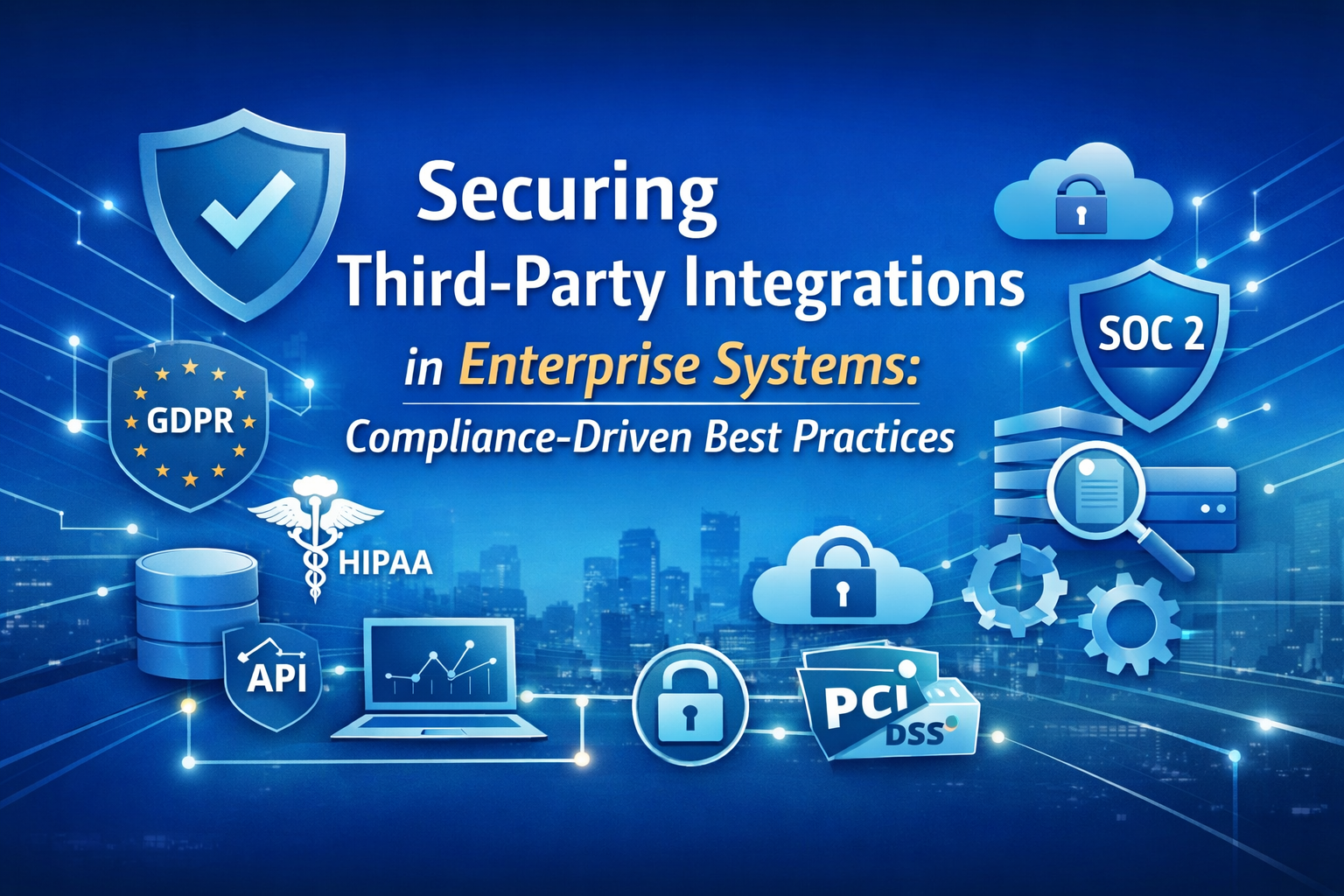
Securing Third-Party Integrations in Enterprise Systems: Compliance-Driven Best Practices
Enterprise systems no longer operate on their own. To meet compliance, scale, and operational demands, they connect to analytics platforms, cloud services, payment providers, and many other third-party tools that support modern business operations.
At the same time, every new connection increases security and compliance risk. Third parties often receive ongoing access to sensitive data and critical systems. Modern regulations expect enterprises to maintain control, visibility, and accountability, even when data is processed outside their direct environment.
Securing third-party integrations is no longer just a security concern. It is a compliance responsibility. Organizations must demonstrate that integrations are governed, monitored, and aligned with regulatory and industry requirements.
This article explains how enterprises secure third-party integrations using a compliance-driven approach. It covers key regulations, vendor risk management, monitoring practices, and a real-world use case.
Why Third-Party Integrations Increase Enterprise Risk
Enterprise systems rely heavily on third-party integrations to connect internal platforms with cloud services, analytics tools, payment providers, and external vendors. These integrations enable scale and speed but also expand the attack surface.
Once connected, third parties often gain persistent access to enterprise data and workflows. Security teams must protect systems they do not fully control while compliance teams remain accountable for regulatory obligations tied to that data.
In recent industry findings, 30% of data breaches involve third-party suppliers and vendors, highlighting how external access points remain a leading source of enterprise security incidents
According to the Verizon Data Breach Investigations Report, approximately 19 percent of security breaches involve third-party or supply chain relationships. This makes external integrations a consistent and material enterprise risk.
For regulated organizations, the impact extends beyond breaches. A single poorly governed integration can trigger audit findings, regulatory penalties, and loss of customer trust.
Why Compliance Is Central to Integration Security
Modern regulations place responsibility on the organization that owns the data, not the vendor that processes it. Even when a compliance failure originates with a third party, enforcement actions typically target the enterprise.
Third-party integrations directly affect compliance because they determine:
• Who can access regulated data
• How data is processed and transmitted
• Whether audit evidence exists
• Whether regulatory obligations can be fulfilled on time
As integration ecosystems grow, mismanaged compliance exposure grows with them. Security controls that are not aligned with compliance frameworks create hidden risk.
Key Regulations That Impact Third-Party Integrations
Different regulations apply depending on data type, geography, and industry. Third-party integrations often sit at the intersection of multiple frameworks.
Common compliance drivers include:
• Privacy regulations governing personal data
• Industry standards for healthcare and financial data
• Assurance frameworks required by enterprise customers
• Government and public sector security mandates
Understanding which regulations apply is the foundation of integration governance.
Compliance Comparison: How Regulations Affect Third-Party Integrations
| Compliance Framework | Primary Scope | Who It Applies To | Third-Party Integration Requirements | Enterprise Risk If Not Compliant |
|---|---|---|---|---|
| GDPR | Personal data protection in the EU | Organizations processing EU resident data | Data minimization, processor agreements, access control, auditability | Regulatory fines, enforcement actions, reputational damage |
| HIPAA | Protected health information | Healthcare providers, payers, vendors | Business Associate Agreements, logging, access control, breach notification | Civil penalties, loss of trust, regulatory sanctions |
| SOC 2 | Trust and security assurance | SaaS and service organizations | Vendor control alignment, monitoring evidence, access governance | Audit exceptions, loss of customer trust |
| PCI DSS | Payment card data | Organizations handling cardholder data | Encryption, restricted access, secure payment integrations | Payment processing restrictions, fines |
| ISO 27001 | Information security management | Global enterprises | Supplier risk management, documented controls, continuous monitoring | Certification loss, governance gaps |
| CCPA and CPRA | Consumer privacy in California | Businesses handling CA resident data | Data access and deletion fulfillment, service provider oversight | Regulatory penalties, consumer complaints |
| NIST CSF | Cybersecurity risk framework | Public and private organizations | Third-party risk identification, detection, response coordination | Increased breach likelihood |
| FedRAMP | Government cloud security | Federal service providers | Authorized integrations, continuous monitoring | Contract disqualification |
| SOX | Financial reporting controls | Public companies | Access governance, change management, audit trails | Financial misstatements, legal exposure |
| GLBA | Financial customer data | Financial institutions | Vendor oversight, secure data sharing | Regulatory enforcement |
| HITRUST | Healthcare security framework | Healthcare and vendors | Integrated control alignment, risk assessments | Compliance failures, trust erosion |
This table helps enterprises quickly assess which compliance obligations apply to their integration landscape and where governance gaps may exist.
Managing Vendor Risk Through Compliance Controls
Managing vendor risk is a core part of meeting compliance requirements. Third-party vendors often access sensitive data and systems, which means their controls directly affect an organization’s regulatory posture.
Effective enterprises apply compliance-aligned controls such as:
Pre-integration risk assessments
Evaluate vendors based on data sensitivity, regulatory exposure, and security maturity.
Contractual compliance obligations
Define breach notification timelines, audit rights, and data handling responsibilities.
Access scoping based on regulation
Limit third-party access according to applicable privacy and industry standards.
Ongoing vendor reviews
Reassess vendors as regulations, data usage, or system architectures change.
Compliance failures frequently occur when vendor oversight stops after onboarding.
Monitoring and Audit Readiness for Integrated Systems
Monitoring provides the operational evidence required to demonstrate compliance.
Key practices include:
Centralized logging across integrations
Capture access events, data transfers, and configuration changes.
Behavior-based anomaly detection
Identify unusual usage patterns that may indicate misuse or compromise.
Audit-ready documentation
Maintain records of controls, reviews, and monitoring aligned with regulatory expectations.
Regular compliance validation
Test integrations against regulatory requirements, not just internal policies.
Without monitoring, compliance remains theoretical rather than defensible.
Real-World Enterprise Use Case
A global enterprise operating across North America and Europe relied on dozens of third-party integrations to support customer data management, analytics, and cloud operations.
The Challenge
The organization faced:
• Limited visibility into which vendors accessed regulated data
• Over-permissioned APIs across multiple systems
• Inconsistent compliance documentation for GDPR and SOC 2 audits
• Increased scrutiny from healthcare clients with HIPAA requirements
Despite strong internal security controls, integration governance lagged behind system growth.
The Approach
The enterprise implemented a compliance-driven integration strategy:
• Created a centralized inventory of all integrations
• Classified vendors by regulatory exposure
• Aligned access controls with GDPR, HIPAA, and SOC 2 requirements
• Centralized monitoring and audit evidence
The Outcome
• Reduced excessive third-party data access
• Improved audit readiness and response time
• Increased confidence in scaling integrations
• Strengthened trust with enterprise customers
The organization moved from reactive compliance remediation to proactive governance.
Building a Scalable Compliance-Driven Integration Strategy
Enterprises that mature integration security treat compliance as a design principle.
Core elements include:
• Centralized integration governance
• Regulation-aware access control models
• Continuous monitoring and audit evidence
• Cross-functional ownership across security, legal, and compliance teams
• Executive visibility into integration risk
This approach enables growth without increasing regulatory exposure.
Conclusion
Third-party integrations are essential to modern enterprise systems. When poorly governed, they create security gaps and compliance exposure. When managed well, they support growth and build trust.
Strong integration security starts with understanding which regulations apply. It continues with clear vendor controls, limited access, and continuous monitoring. Most importantly, it requires treating compliance as an ongoing process, not a one-time effort.
At AcmeMinds, we help enterprises design secure and compliant integration frameworks that scale with their systems. Our work focuses on reducing third-party risk, improving audit readiness, and aligning security controls with regulatory requirements.
You can explore more on this topic through:
• Cybersecurity Essentials for Modern Enterprises
• Building Secure APIs in 2026: Best Practices for Authentication and Authorization
Securing third-party integrations is not only about avoiding risk. It is about creating a foundation for reliable, compliant, and scalable enterprise systems.
FAQs
1. What is third-party integration compliance?
Third-party integration compliance refers to ensuring that external systems connected to enterprise platforms meet applicable regulatory, security, and contractual requirements.
2. Why do third-party integrations create compliance risk?
Third-party integrations extend data access beyond direct enterprise control, making oversight, monitoring, and auditability more complex.
3. Which regulations most commonly affect integrations?
Integrations are commonly affected by privacy laws, healthcare regulations, financial compliance standards, and security assurance frameworks.
4. How can enterprises reduce integration-related compliance risk?
Enterprises can reduce compliance risk by centralizing governance, limiting access, monitoring integration activity, and enforcing clear vendor accountability.
5. Are integrations included in SOC 2 audits?
Yes. Integrations are evaluated in SOC 2 audits based on their impact on security, availability, and confidentiality controls.
6. Who owns integration compliance in an enterprise?
Integration compliance ownership is shared across security, IT, legal, procurement, and compliance teams, with executive oversight.